Home › Blog › Borrowing guides › First-Time Borrower Loans in the Philippines
First-Time Borrower Loans in the Philippines
No credit history, no payslip, first loan? Here is where first-time borrowers actually get approved, what it costs, and how to get better offers next time.
Published October 30, 2026
You just started your first job, or your first freelance gig, and payday is ten days away. The rent is short by ₱3,000. You download a loan app, fill in everything, and get a polite "Sorry, we can't approve you right now." No reason, no number to call. Welcome to the first-loan problem: lenders want a track record, and you cannot build one without a loan.
The good news is that it is easier to get a first loan in the Philippines today than it was a few years ago. Many registered apps are built for people with no credit history, and a growing number of lenders now check your record with the Credit Information Corporation (CIC) instead of asking for payslips and bank statements.
The bad news is that first loans are usually small, short and expensive, and a bad first experience can follow you for years. This guide shows how to get approved for a first loan, what it really costs in pesos, and how to turn it into a credit record that gets you better offers next time.
Why lenders hesitate with first-time borrowers
A lender's main question is simple: will this person pay back on time? With an experienced borrower, the answer is in the credit report. With you, there is nothing to read, so the lender has to guess, and it guesses carefully.
That is why first-time borrowers usually see three things. The first limit is low, often a fraction of the maximum an app advertises. The term is short. And the price is higher than what repeat customers get. None of this is personal. It is the lender protecting itself until you prove yourself.
Credit records in the Philippines are growing fast. The CIC produced about 27 million credit reports in 2025, nearly three times the roughly 9 million in 2024, and online lenders accounted for about half of them, BusinessWorld reported in 2026. The CIC has also added postpaid mobile data from major telcos and plans to push for utility data. So paying bills and loans on time increasingly shows up on your record.
Where first-time borrowers can actually get a loan
Not every lender wants new customers. Here are the realistic starting points, and what to watch for with each.
| Option | How first-timers get in | Watch out for |
|---|---|---|
| Small-loan apps | One ID and a phone number | High fees on short terms |
| Pay-later apps | One ID, often no payslip | Service charges on cash loans |
| Store installments | Apply at the counter | Promo price vs cash price |
| E-wallet loans | By invitation, based on usage | No way to apply on demand |
| Employer salary advance | Ask HR | Policy varies by company |
Small-loan apps built for no credit history
Some apps are designed exactly for people without a record. Tala, for example, asks for at least one valid ID and a mobile number, does not require a bank account, and gives credit limits of ₱1,000 to ₱25,000 according to its Google Play listing, with first limits usually at the lower end. Our Tala review explains its fees in detail.
Pay-later apps
BillEase says a valid government ID is usually enough and that freelancers can apply, with loan amounts from ₱500 to ₱50,000 and modest first limits. Its 0% store promos are the cheapest way in. See our BillEase review for how its three products differ.
Store installments
If you need a phone, laptop or appliance anyway, a store installment is often the gentlest first loan. Home Credit, for example, sells installments at partner stores and offers 0% options on select products. Its cash loans are currently offered only to existing customers, so a paid-off store installment is also how many people unlock a cash loan offer later. Our Home Credit cash loan review covers what that next step costs.
E-wallet loans
If you already use GCash a lot, you may get a GLoan offer based on your GScore. You cannot simply apply; the offer appears when GCash decides you qualify.
What a first loan really costs
First loans look small, so the cost feels small too. Here is what the official examples from three registered lenders work out to in pesos.
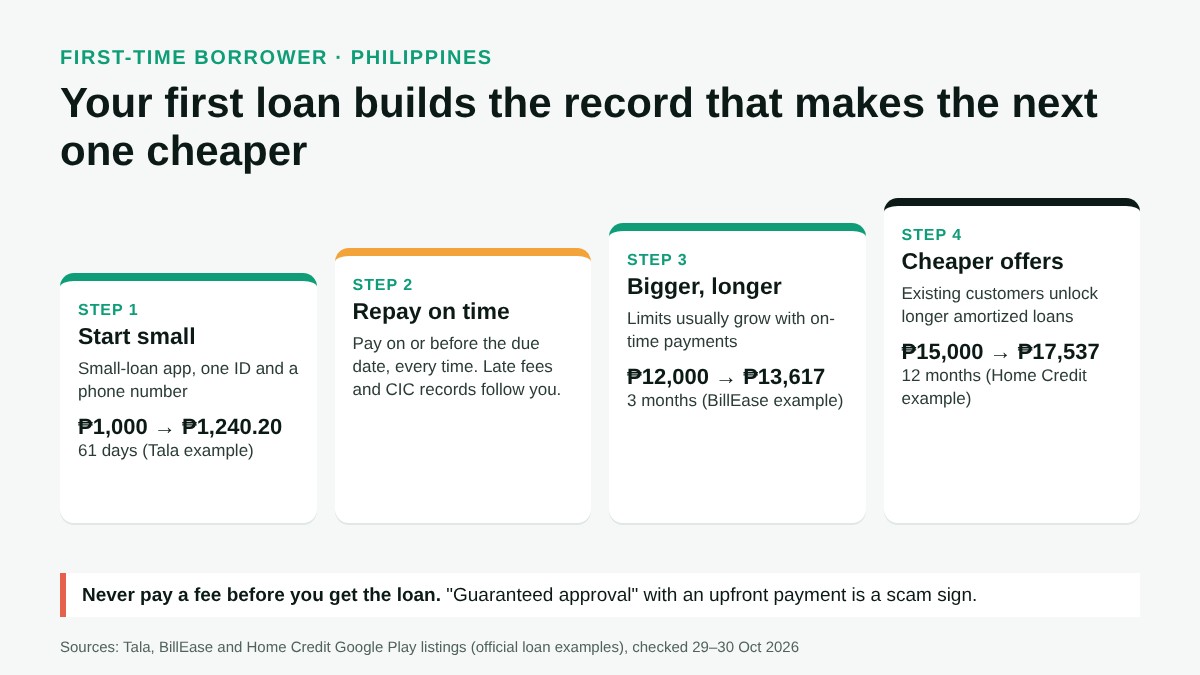
| Example | You borrow · you repay | Cost |
|---|---|---|
| Tala official example, 61 days | ₱1,000 · ₱1,240.20 | ₱240.20 |
| Same Tala structure, 61 days | ₱3,000 · ₱3,720.60 | ₱720.60 |
| BillEase official example, 3 months | ₱12,000 · ₱13,617 | ₱1,617 |
| Home Credit official example, 12 months | ₱15,000 · ₱17,537 | ₱2,537 |
How we calculated: rows one, three and four are the lenders' own examples from their Google Play listings. Row two scales the fees in Tala's example (a ₱99.90 processing fee, or 9.99%, and ₱140.30 of service fees over 61 days, or 0.23% a day) to ₱3,000. Your real offer may be different, so always read the disclosure statement.
The Tala example works out to about 11–12% a month, the same range Tala's listing gives as its monthly effective rate. That sounds high, and it is, but it is typical for very short, small loans, and it sits right at the SEC's 2026 ceiling of 12% a month effective interest for loans of ₱10,000 or less with terms of up to four months. Our guide to the 2026 interest rate cap explains what that ceiling covers.
The real lesson is in the last two rows. Longer loans from lenders that already know you cost far less per month. Your first loan is not the cheap one. It is the one that makes cheaper ones possible.
Before you accept your first offer, it pays to see what else you qualify for. You can compare offers from our partners in a few minutes and pick the one with the lowest total to repay.
Real-life scenarios
"I'm 22, it's my first job, and I need ₱3,000 until payday." Borrow only the ₱3,000, not the ₱5,000 the app suggests. On a Tala-style structure, ₱3,000 for 61 days costs about ₱720. If your app charges a daily service fee and lets you repay early, paying on payday instead of day 61 cuts that cost. Pick the shortest term you can actually meet.
"I'm a freelancer with no payslip and need a ₱15,000 laptop for work." Look for a 0% store installment or a pay-later promo first. If the installment price equals the cash price, you are borrowing for free and building a record at the same time.
"I applied to five apps and got rejected by all of them." Stop applying for a few weeks. A string of rejections usually means something in your profile needs fixing, and applying to more apps will not change that. Fix the basics first: an ID that matches your details, a phone number in your name, and an e-wallet or bank account you actually use.
"A Facebook page says I'm pre-approved for ₱50,000, I just need to pay a ₱1,500 fee." That is a scam. Registered lenders deduct fees from the loan or add them to the repayment; they never ask you to pay before you get the money. See the loan scam red flags to know the other signs.
Key point. Your first loan is not about the money. It is about the record. Borrow a small amount you can repay early or on time, from a registered lender, and the next offer will usually be bigger, longer and cheaper.
How to turn your first loan into good credit
Lenders reward boring borrowers. Pay on or before the due date, every time, and your limit and terms usually improve. Tala's limits usually grow with on-time repayment, and BillEase says borrowers who pay on time can get higher limits and longer terms.
Avoid the two traps that hurt first-timers most. The first is stacking: taking a second loan to pay the first. If you cannot repay, talk to the lender before the due date instead. The second is borrowing the full limit just because it was offered. A bigger loan is only better if you can repay it.
Late payments matter more than you think. GCash's GLoan terms, for example, say unpaid loans can be reported to the CIC, and Tala charges a late fee of 5% of the outstanding balance after the loan term. Our guide on what happens if you miss a loan payment covers your options if things go wrong.
Your first-loan checklist
- Decide the exact amount you need and the date you can repay it.
- Check that the lender is on the SEC's list of recorded online lending platforms. Our legit loan apps guide is a good start.
- Prepare one valid government ID, a phone number in your name, and an active e-wallet or bank account.
- Apply to one or two lenders at a time, not ten.
- Read the disclosure statement and write down the total you will repay.
- Never pay any fee before you receive the loan.
- Set a reminder a few days before the due date and repay on time or early.
- Wait for a better offer instead of taking a new loan right away.
Quick answers
Can I get a loan with no credit history in the Philippines? Yes. Several registered apps, including Tala and BillEase, lend to people without a credit record, usually starting with small limits that grow with on-time payments.
How much can I borrow on my first loan? Usually a small amount. Tala's listing gives a range of ₱1,000 to ₱25,000 and BillEase's ₱500 to ₱50,000, but first limits tend to sit at the low end.
What is the easiest loan to get for a first-time borrower? Small-loan apps and pay-later apps that need only one ID are usually the easiest. A 0% store installment is often the cheapest.
Do I need a payslip for my first loan? Not always. Many apps ask only for a valid ID and a phone number, and BillEase says freelancers can apply. Lenders may still ask for more documents.
Is it legit if an app says my first loan is guaranteed? No legit lender guarantees approval. A promise of guaranteed approval, especially with an upfront fee, is a classic scam sign.
Does my first loan build my credit score? It can. More and more lenders use CIC records, and some, such as GCash's GLoan, say unpaid loans can be reported to the CIC. Paying on time helps your record; paying late hurts it.
Start small, and compare first
Your first loan should be small, short and from a registered lender, with a clear plan to repay it. Before you sign, compare offers from our partners on the total amount to repay, and choose the one you are sure you can pay on time.
Sources: Tala Google Play listing (updated 2 September 2026, checked 30 October 2026); BillEase Google Play listing and FAQ (checked 29 October 2026); Home Credit Google Play listing and cash loan page (checked 30 October 2026); GCash GLoan terms as summarized in our GCash guide; BusinessWorld, 2026, on CIC credit report volumes; SEC rules on interest ceilings effective 1 April 2026. The ₱3,000 example is our calculation. This article is general information, not legal or financial advice.
Ready to check your offer with Crezu?

Crezu
Compare available personal loan options online
Review eligibility, repayment amount, interest, fees and all terms on the provider's website before applying